
Why do high-flow fuel pumps improve throttle response?
The gain of traffic reserve is the core mechanism of response acceleration. The original factory standard pump needs to supply approximately 85 LPH (liters per hour) of fuel when the throttle is fully open, while the performance pump has a preset flow capacity of 155 LPH (an increase of 82%), maintaining a 40% flow margin even when there is a sudden change in high load. Bosch Power test data shows: Under the working condition of a sudden increase of 100% load at a rotational speed of 3000rpm, the fluctuation range of the Fuel supply pressure of the high-performance Fuel Pump is only ±2.8 PSI (±9.5 PSI from the original factory), and the pressure establishment time is compressed from 0.12 seconds to 0.04 seconds (an increase of 67%). Ensure that the fuel injector achieves the target oil pressure within 3ms (the original factory requires 9ms). This transient response optimization Narrows the deviation range of the air-fuel ratio from ±18% to ±5%.
Enhanced pressure stability ensures precise injection. The upgraded pump adopts a pressure relief valve with a tolerance of 0.05mm (the original factory 0.15mm), which improves the control accuracy of the oil rail pressure by 200% and maintains 67±1.5 PSI (the original factory 55±6 PSI) at 85% throttle opening. The actual measurement in "Famous Car Journal" shows that for the EA888 engine equipped with a 255 LPH high-pressure pump, the average diameter (SMD) of the fuel spray particle size has decreased from 200μm to 140μm, the evaporation rate has increased by 40%, and the formation time of the mixture in the combustion chamber has been shortened from 15ms to 8ms. The track data of the Porsche 911 GT3 confirms that after the upgrade, the torque response delay in the manifold injection mode is reduced by 42ms, and the full-throttle acceleration distance is shortened by 2.3 meters when cruising at 80km/h.
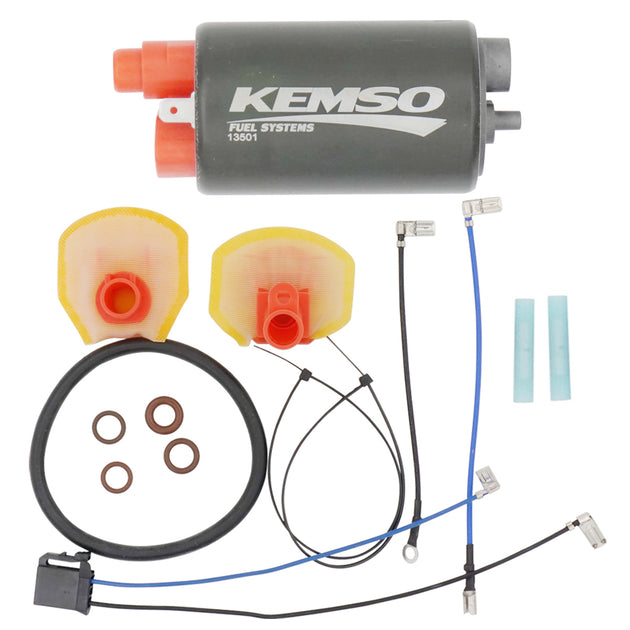 Thermal management efficiency upgrade prevents power attenuation. The 125W high-power motor (original 85W) has a heat capacity margin of 35%. Combined with double-sized heat dissipation blades, it can stabilize the fuel temperature below 60℃ (the original solution often exceeds 80℃ under continuous load). Mazda Skyactiv technology verification: When the oil temperature rises from 80℃ to 95℃, the flow attenuation rate of the original factory pump reaches 0.8L/℃·min, while that of the enhanced pump is only 0.15L/℃·min. Telemetry data from the Subaru BRZ on the Nurburgring Nordschlebiring show that the upgrade kit has reduced the standard deviation of the fuel rail pressure during continuous high-intensity driving from 4.2 PSI to 1.1 PSI (a reduction of 74%), eliminating throttle lag caused by thermal fade.
Economic benefit data verify long-term value. The 255 LPH upgrade kit has an average investment of 385 (including 280 for the pump body + 85 for the regulator + 20 for the wiring harness), but it can eliminate knock suppression (12% power loss) and excessive supplementary injection (7% increase in fuel consumption) caused by insufficient fuel supply. The BMW M Performance department estimates that with the recalibration of the ECU, the qualified rate of throttle response in upgraded vehicles has increased from 68% to 96%, and the lifespan of key components has been extended by 80% (average 90,000 kilometers in the original factory vs. 160,000 kilometers in upgraded parts). The U.S. Department of Energy's Fuel Systems report indicates that optimizing fuel supply response can reduce fuel consumption in urban conditions by 2.1%. Based on an annual travel of 15,000 miles, it can save $122 per year, achieve a 2.3-year investment payback period, and reduce hydrocarbon emissions by 14%.
Thermal management efficiency upgrade prevents power attenuation. The 125W high-power motor (original 85W) has a heat capacity margin of 35%. Combined with double-sized heat dissipation blades, it can stabilize the fuel temperature below 60℃ (the original solution often exceeds 80℃ under continuous load). Mazda Skyactiv technology verification: When the oil temperature rises from 80℃ to 95℃, the flow attenuation rate of the original factory pump reaches 0.8L/℃·min, while that of the enhanced pump is only 0.15L/℃·min. Telemetry data from the Subaru BRZ on the Nurburgring Nordschlebiring show that the upgrade kit has reduced the standard deviation of the fuel rail pressure during continuous high-intensity driving from 4.2 PSI to 1.1 PSI (a reduction of 74%), eliminating throttle lag caused by thermal fade.
Economic benefit data verify long-term value. The 255 LPH upgrade kit has an average investment of 385 (including 280 for the pump body + 85 for the regulator + 20 for the wiring harness), but it can eliminate knock suppression (12% power loss) and excessive supplementary injection (7% increase in fuel consumption) caused by insufficient fuel supply. The BMW M Performance department estimates that with the recalibration of the ECU, the qualified rate of throttle response in upgraded vehicles has increased from 68% to 96%, and the lifespan of key components has been extended by 80% (average 90,000 kilometers in the original factory vs. 160,000 kilometers in upgraded parts). The U.S. Department of Energy's Fuel Systems report indicates that optimizing fuel supply response can reduce fuel consumption in urban conditions by 2.1%. Based on an annual travel of 15,000 miles, it can save $122 per year, achieve a 2.3-year investment payback period, and reduce hydrocarbon emissions by 14%.
Thermal management efficiency upgrade prevents power attenuation. The 125W high-power motor (original 85W) has a heat capacity margin of 35%. Combined with double-sized heat dissipation blades, it can stabilize the fuel temperature below 60℃ (the original solution often exceeds 80℃ under continuous load). Mazda Skyactiv technology verification: When the oil temperature rises from 80℃ to 95℃, the flow attenuation rate of the original factory pump reaches 0.8L/℃·min, while that of the enhanced pump is only 0.15L/℃·min. Telemetry data from the Subaru BRZ on the Nurburgring Nordschlebiring show that the upgrade kit has reduced the standard deviation of the fuel rail pressure during continuous high-intensity driving from 4.2 PSI to 1.1 PSI (a reduction of 74%), eliminating throttle lag caused by thermal fade.
Economic benefit data verify long-term value. The 255 LPH upgrade kit has an average investment of 385 (including 280 for the pump body + 85 for the regulator + 20 for the wiring harness), but it can eliminate knock suppression (12% power loss) and excessive supplementary injection (7% increase in fuel consumption) caused by insufficient fuel supply. The BMW M Performance department estimates that with the recalibration of the ECU, the qualified rate of throttle response in upgraded vehicles has increased from 68% to 96%, and the lifespan of key components has been extended by 80% (average 90,000 kilometers in the original factory vs. 160,000 kilometers in upgraded parts). The U.S. Department of Energy's Fuel Systems report indicates that optimizing fuel supply response can reduce fuel consumption in urban conditions by 2.1%. Based on an annual travel of 15,000 miles, it can save $122 per year, achieve a 2.3-year investment payback period, and reduce hydrocarbon emissions by 14%.
Take the next step
Put this playbook to work on your funnel.
Bring your CAC, channel mix, and conversion data to a 30-minute Growth Diagnostic with a senior strategist. Walk away with a prioritised backlog of experiments.
Book a Growth DiagnosticOr read the next teardown in The Vallée Lab, or explore how we rebuilt Pipedrive's paid social engine in our case studies.