
In-House or External? How a Brand Team Should Learn Perfumery
External courses deliver structure and a recognised vocabulary; in-house sessions deliver relevance and cost control. Neither wins outright, and the decision usually turns on who attends, how long the capability needs to last and whether the team already shares any language for describing smell. The arrangement that outperforms both is a short external spine followed by disciplined internal practice.
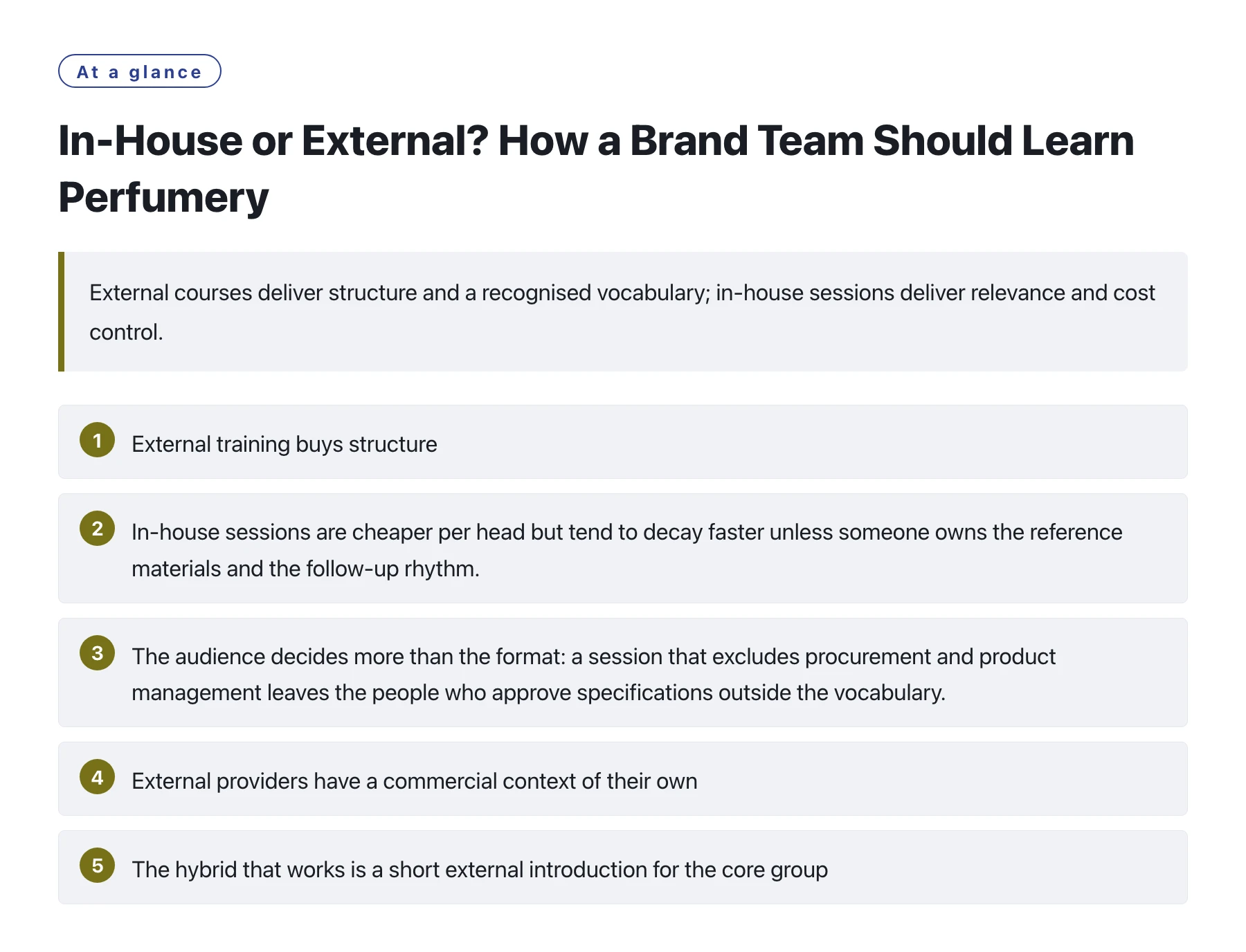
Key takeawaysExternal training buys structure, a shared standard and contact with people from other companies; in-house training buys relevance to your own briefs and materials. · In-house sessions are cheaper per head but tend to decay faster unless someone owns the reference materials and the follow-up rhythm. · The audience decides more than the format: a session that excludes procurement and product management leaves the people who approve specifications outside the vocabulary. · External providers have a commercial context of their own, whether they are academies, suppliers or independent perfumers, and the syllabus reflects it. · The hybrid that works is a short external introduction for the core group, followed by internal practice against live briefs and a retained reference kit.
The question is usually framed as a budget decision, but the budgets involved are smaller than the cost of getting it wrong. A team that cannot describe a smell precisely will spend more in development rounds than any training programme costs, because every vague brief is paid for a second time.
So the useful comparison is not price per session. It is which format produces a team that can brief, evaluate and decide without a translator.
Two formats, judged on the things that decide the outcome
In-house training is run by someone the team already knows, on materials the brand already uses, at a time that fits the product calendar. External training is run away from the office, in a setting built for teaching, often alongside people from other brands.
Each format is good at something the other finds difficult. The comparison only becomes useful when it is broken down by criterion, because a format can win on cost and lose badly on retention.
In-house against external, criterion by criterion
| Criterion | In-house | External |
|---|---|---|
| Cost per participant | Low, if the trainer is internal or a supplier | Higher, and travel adds to it |
| Relevance to your briefs | High, because you choose the materials | Variable, and typically broader than your category |
| Quality of teaching | Depends on whoever is available | Depends on the provider, but teaching is their job |
| Shared vocabulary afterwards | Built around your own templates | Built around a recognised industry standard |
| Retention after three months | Poor without an owner and a rhythm | Better at first, still fades without practice |
| Exposure to other brands | None | High, and often the most valuable side effect |
| Scheduling flexibility | Fits around the product calendar | Fixed dates and fixed locations |
Read the retention row first. It is the one that decides whether the money produced a capability or an afternoon out, and it is the row most training plans ignore.
When each format is the right answer
The two formats are rarely in direct competition once the audience and the timeline are clear. What matters is matching the format to what the team needs next quarter.
Choose external when the vocabulary is missing
If the team has no shared words for smell, an external programme is usually the faster route, because it arrives with a framework and forces comparison across a wider range than your own shelf holds. Industry bodies such as The Fragrance Foundation run education and recognition work for the trade, and that shared reference point is part of what external training sells [1].
The constraint is relevance. A course built around fine fragrance materials will not automatically prepare a team that develops home fragrance or scented body products, and the gap has to be closed internally afterwards.
Choose in-house when the gap is your own process
If the team already has some vocabulary but writes weak briefs, the problem is closer to process than to knowledge. That is better solved on your own material: take three briefs that went badly, go through them with the samples, and work out where the description failed. No external course can do that, because the material is yours.
The hybrid that usually wins
A short external introduction for a core group, followed by internal sessions against live briefs, tends to outperform either format alone. The external part installs the map and the standard; the internal part keeps it in contact with the work.
It also distributes the cost sensibly. Send four or five people to the external programme rather than the whole team, then let them run the internal practice. That model has a second advantage: it creates internal owners instead of dependence on an outside provider.
One question settles most of the debate: who will run the session six months from now? If nobody can answer that, the format does not matter much, because the capability will not survive the quarter.
A third option: the manufacturer's education arm
Development houses increasingly run their own training, and the academy is a third option that sits between the two columns above. It has the structure of an external provider and the material relevance of an in-house session, because the people teaching also make the products.
The obvious limitation is commercial context. A supplier's programme will reflect what that supplier does well, which is useful for understanding manufacturability and cost, and less useful as a neutral survey of the market. Used deliberately, that is an advantage rather than a flaw: a team that understands how a factory thinks writes briefs that are cheaper to answer.
It is also a way to see the wider craft rather than only the product. The academy run by XUELEI sits alongside a scent museum a museum built around smell whose pages describe collections and exhibits, and exposure to a curated collection is difficult to replicate in a meeting room. For a niche brand, understanding how scent carries meaning is part of the positioning work, not a distraction from it, which is why the questions to answer before approaching a factory what niche fragrance brands need from a factory include knowing what the brand wants the smell to do.
Whatever format a brand picks, the refillable question deserves its own slot. A team that has only ever smelled sealed testers in a meeting room is poorly prepared for a format where the customer opens, pours and reseats the product repeatedly. Add the comparison to the programme, and make it a habit afterwards.
How to judge whether it worked
Judge the programme on the quality of the briefs that follow it and on how many clarification calls a perfumer needs before responding. Both are recorded in ordinary project files, and both improve quickly when a team shares a vocabulary and a reference kit.
Commercial pressure is pushing in the same direction. Consumer research houses such as Mintel regularly publish on refill, reuse and packaging claims in beauty, which means the teams buying development work are increasingly asked to explain a scent in the language of a claim [2]. Training is what makes that conversation specific rather than decorative.
A second measure is speed: how long it takes from brief to a sample the team considers close. That interval depends on many things, but a vague brief is reliably at the front of the queue of causes.
Sources
- The Fragrance Foundation —— A non-profit organisation for the fragrance industry, running perfumery education programmes and industry recognition.
- Mintel Press Centre —— Mintel's press releases on consumer and beauty market research, including fragrance and personal care trend reporting.
Frequently asked questions
Is external perfumery training worth the cost?
It usually is when the team lacks a shared vocabulary, because it delivers a framework and a recognised standard quickly. It is poor value when the real gap is the brand's own briefing process, which no outside course can fix.
Can a supplier train our team without turning it into a sales pitch?
Partly. Expect the material to reflect that supplier's strengths, and set the agenda yourself: ask for manufacturability, cost drivers and constraints rather than a product tour. Pair it with neutral practice on your own briefs.
How many people should attend an external course?
A core group of four or five is usually enough to seed the vocabulary internally. Sending the whole team multiplies the cost without multiplying the retention.
What is the biggest reason training fades?
Nobody owns it afterwards. Without a named keeper for the reference materials and a small recurring practice rhythm, most of the vocabulary is gone within a quarter.
Does the format of the product change what we should teach?
Yes. A refillable line needs an additional module comparing the scent as sealed with the scent after a refill, because the customer handles the product differently in that format.
Put this playbook to work on your funnel.
Bring your CAC, channel mix, and conversion data to a 30-minute Growth Diagnostic with a senior strategist. Walk away with a prioritised backlog of experiments.
Book a Growth DiagnosticOr read the next teardown in The Vallée Lab, or explore how we rebuilt Pipedrive's paid social engine in our case studies.