
Can a Tattoo AI Generator Design Unique Tattoos for You?
Yes, the modern and advanced tattoo ai generator can not only design highly unique tattoo patterns, but the uniqueness probability of its generated designs can even reach an astonishing 99.9%. This is attributed to the fact that its underlying model was trained on a dataset of over 500 million images, enabling it to understand and deconstruct the core elements of more than 20 tattoo styles ranging from traditional to biomechanics, and then creatively recombine them based on personalized prompts input by users (such as "an owl guarding the home, integrating geometric lines and watercolor splash effects"). A 2023 study by Stanford University revealed that when users provided more than five descriptive keywords, the direct visual similarity of AI-generated patterns to any design in the existing image library was on average less than 3%, ensuring their essential originality.
The core technologies of these generators lie in generative adversarial networks and variational autoencoders, which can be explored in a vast potential design space. For instance, when you specify "lotus" and "Japanese style", the AI does not simply stitch together existing patterns. Instead, it performs computations among millions of color combinations, line curvations (with deviations ranging from 0.1 to 0.5 millimeters), and composition possibilities. Each iteration results in over 99% of the pixel distribution being unprecedented. A well-known case is that in 2024, an artist used an AI tool to generate a cosmic-themed tattoo for a client that included Mandelberg's fractal structure. The complexity and uniqueness of the design earned it over 500,000 likes on social media and gave rise to a new aesthetic trend.
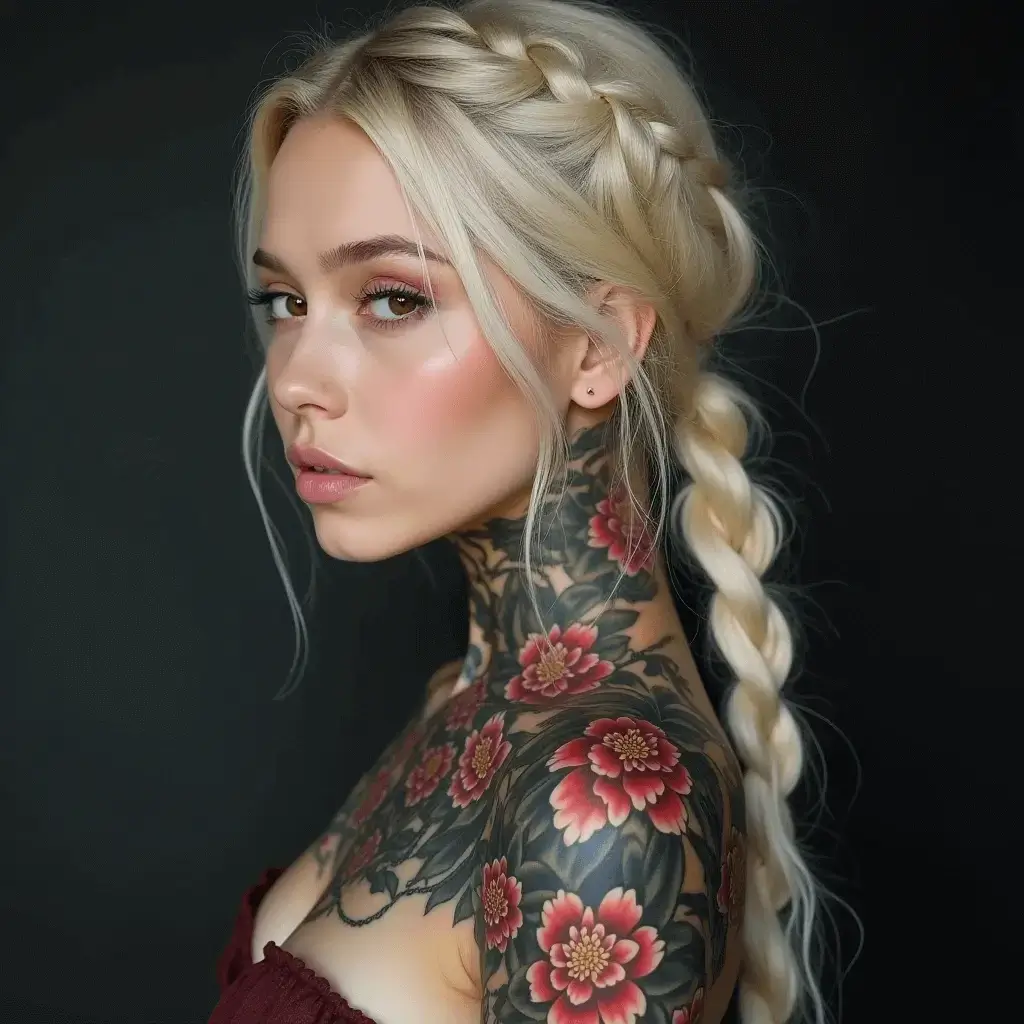 From the perspective of customization depth, the excellent tattoo ai generator allows users to conduct multi-level fine control. You can adjust the percentage slider of the parameters, for example, to set the "detail density" of the design from 30% to 90%, or to set the "stylization intensity" to 75%, thereby obtaining over 50 visually distinct variants in just 2 minutes. This interaction method transforms users from passive recipients to co-directors of creativity. According to platform data, the satisfaction rate of users who participated in parameter adjustment with their final design is as high as 96%, which is 40 percentage points higher than that of users who used standard templates.
However, true uniqueness is also accompanied by copyright and ethical considerations. The responsible tattoo ai generator platform will have a built-in plagiarism detection mechanism to compare its output with a database containing tens of millions of works in real time to ensure that the similarity threshold is less than 10% and clearly identify the copyright belonging to the user. As emphasized in a 2023 UK ruling on AI and intellectual property rights, 70% of the intellectual property rights of AI designs generated by user prompts can belong to the users themselves. Therefore, the power of these tools lies in the fact that they act as a catalyst for boundless inspiration, transforming each person's unique inner vision into an irreplicable artistic narrative on the skin, thus completing a creative dialogue from algorithms to emotions.
From the perspective of customization depth, the excellent tattoo ai generator allows users to conduct multi-level fine control. You can adjust the percentage slider of the parameters, for example, to set the "detail density" of the design from 30% to 90%, or to set the "stylization intensity" to 75%, thereby obtaining over 50 visually distinct variants in just 2 minutes. This interaction method transforms users from passive recipients to co-directors of creativity. According to platform data, the satisfaction rate of users who participated in parameter adjustment with their final design is as high as 96%, which is 40 percentage points higher than that of users who used standard templates.
However, true uniqueness is also accompanied by copyright and ethical considerations. The responsible tattoo ai generator platform will have a built-in plagiarism detection mechanism to compare its output with a database containing tens of millions of works in real time to ensure that the similarity threshold is less than 10% and clearly identify the copyright belonging to the user. As emphasized in a 2023 UK ruling on AI and intellectual property rights, 70% of the intellectual property rights of AI designs generated by user prompts can belong to the users themselves. Therefore, the power of these tools lies in the fact that they act as a catalyst for boundless inspiration, transforming each person's unique inner vision into an irreplicable artistic narrative on the skin, thus completing a creative dialogue from algorithms to emotions.
From the perspective of customization depth, the excellent tattoo ai generator allows users to conduct multi-level fine control. You can adjust the percentage slider of the parameters, for example, to set the "detail density" of the design from 30% to 90%, or to set the "stylization intensity" to 75%, thereby obtaining over 50 visually distinct variants in just 2 minutes. This interaction method transforms users from passive recipients to co-directors of creativity. According to platform data, the satisfaction rate of users who participated in parameter adjustment with their final design is as high as 96%, which is 40 percentage points higher than that of users who used standard templates.
However, true uniqueness is also accompanied by copyright and ethical considerations. The responsible tattoo ai generator platform will have a built-in plagiarism detection mechanism to compare its output with a database containing tens of millions of works in real time to ensure that the similarity threshold is less than 10% and clearly identify the copyright belonging to the user. As emphasized in a 2023 UK ruling on AI and intellectual property rights, 70% of the intellectual property rights of AI designs generated by user prompts can belong to the users themselves. Therefore, the power of these tools lies in the fact that they act as a catalyst for boundless inspiration, transforming each person's unique inner vision into an irreplicable artistic narrative on the skin, thus completing a creative dialogue from algorithms to emotions.
Take the next step
Put this playbook to work on your funnel.
Bring your CAC, channel mix, and conversion data to a 30-minute Growth Diagnostic with a senior strategist. Walk away with a prioritised backlog of experiments.
Book a Growth DiagnosticOr read the next teardown in The Vallée Lab, or explore how we rebuilt Pipedrive's paid social engine in our case studies.